Essay and partial transcription of the March, 2025 talk at Good on Paper Bookstore in Houston, TX with new introduction.
Someday, you will be old enough to start reading fairytales again.
C.S. Lewis The Lion, The Witch, and The Wardrobe
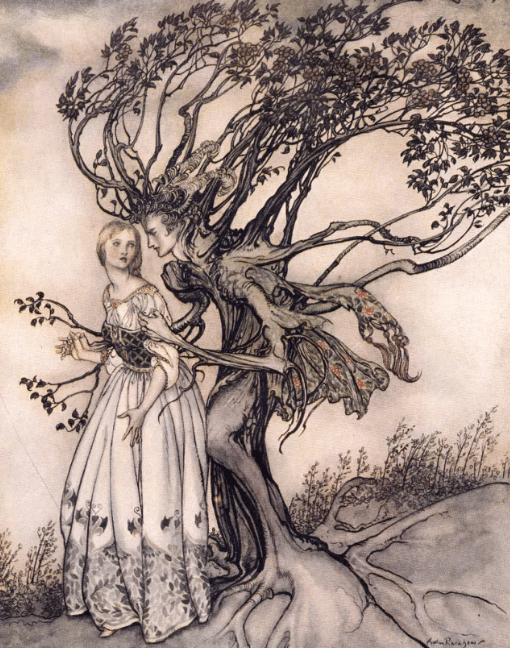
The Old Woman in the Wood, 1917 illustration by Arthur Rackham
Introduction
When I was nine years old, I wrote my first story.
A thirteen line, blank verse poem about a girl whose obsessive pursuit of her own green eyed reflection leads her to the banks of a river called Darkness. Better than any mirror, the river shows the girl her green eyes so perfectly, that either through vanity or desperation, she dives into the water, gets caught up in the currents, and drowns.
A Narcissian tragedy. A little odd for a 5th grader, exciting, dark. My teachers were shocked, my mother, horrified, proud, but horrified. I was a quiet kid. Dyslexic. Middling grades if you didn’t count math. Everything about my story was unexpected because no one had any expectations for me at all back then.
Twenty-one years later, and I still feel that way sometimes. Good Catholic girl. Quiet. Still dyslexic. No one is looking to me for the next great anything. On my bad days, I want to climb onto the roof of my apartment building and declare my genius to the world. But, on my good days, it feels like I’m getting away with something. I can dream, follow every wandering thought, imagine futures for myself without the burden of some special thing everyone is assuming that I will be, because the one special thing that I am was never taken seriously.
I am a storyteller. Actor, artist, writer, and I believe, a good one. But why? Why do I believe that I am good at telling stories? Mine, other people’s, on stage or off, in a picture, on paper, whatever. If I think about it, and I have, I think it’s because I wonder like an adult.
But what does it mean to wonder like an adult, and more importantly, what does that have to do with storytelling?
Not Specifically for Children
Think of some favorite childhood stories. Snow White and the Seven Dwarfs, Peter Pan, Paddington Bear. My favorite growing up was The Lion King. Now, ignoring the fact that The Lion King was a Disney retelling of William Shakespeare’s Hamlet, let’s look at the other stories I’ve listed.
Snow White and the Seven Dwarfs, a Grimm fairytale reimagining released by Disney in 1937, is the story of a young girl who, through the good will and help of her community, overcomes years of emotional abuse at the hands of her stepmother and becomes the woman she was always fated to be.
Peter Pan, written by J.M. Barrie and first published in 1911, is a tale about a young boy who dies before he can grow up. Instead of moving on to heaven, the boy elects to remain in purgatory and act as a protector for the lost souls of other children who passed away too soon. Through adventure and imagination, the boy readies the children to leave their old world behind, and when it’s time, he ushers them out of purgatory and straight on to their next life. A beautiful story about friendship and loss, but what about my last story? Paddington Bear.
A Bear Called Paddington. A heartwarming book series about childhood immigration and the struggles that arise from trying and failing to fit into a culture very different than your own. Written by a man named Michael Bond, the idea for A Bear Called Paddington famously came to him on Christmas Eve of 1956.
“I bought a small toy bear on Christmas Eve 1956. I saw it left on a shelf in a London store and felt sorry for it. I took it home as a present for my wife Brenda and named it Paddington as we were living near Paddington Station at the time. I wrote some stories about the bear, more for fun than with the idea of having them published. After ten days I found that I had a book on my hands. It wasn’t written specifically for children, but I think I put into it the kind things I liked reading about when I was young.“
Michael Bond, The Creator of Paddington Bear
He later went on to share that the inspiration for Paddington bear’s unique arrival from Peru to Paddington Station came directly from his recollection of Jewish refugee children arriving in Britain during WWII. Additionally, the tag Paddington bear wears around his neck in the beginning of A Bear Called Paddington, was directly inspired by his memory of the tags that English children wore around their necks when they were carted off to the safety of the countryside during the London Blitz.
‘Please, look after this child,’ the tags read. ‘Please, look after this bear.’
Michael Bond was a military man during one of the worst wars of our human history. A camera man who worked for The BBC and did not come up with his most celebrated idea until he was thirty years old.
Years after the success of A Bear Called Paddington, at a ceremony for the unveiling of a train named Paddington, Michael Bond’s daughter, Karen Jankel said:
“Had my father lived in another part of the country, or not travelled by train, he might never have come up with the idea for a bear being found at paddington station.”
Never. Like the other stories I’ve outlined, A Bear Called Paddington came from the mind of an adult, and not just from the mind, but from the experiences collected over years, decades even, of living life.
Every great children’s book ever written came from the wonder and imagination of adults. Storytellers who got away with daydreaming far longer than their peers.
So why, then, when I searched for information on adult wonder, was there next to nothing about the benefits and necessity of making space for creativity past early childhood?
There was plenty of good literature about why children benefit from wonder and imagination:
- Critical thinking skills
- Creative problem solving
- Resourcefulness
But grown ups? If the many self-help articles I’ve read over the last week are to be believed, at the very moment of matriculation into adulthood, we unconsciously set fire to all of our why’s– our questions about the world- content ourselves with a frankly inadequate amount of because’s, and what’s worse, we begin to ask questions like:
Why is imagination important?
What is the purpose of creativity?
At what age do we have enough wonder? Enough wonder.
I wish that I could say that these questions or this idea of enough wonder was limited to a few articles on the internet, but over the last twenty years of my life, I have personally witnessed whole arts programs being taken out of high schools. Music, theater, dedicated spaces for creativity defunded and brushed aside. Wonder and imagination deemed extracurricular; non-essential by the time a person is old enough to have a job.
At what age do we have enough wonder?
And what is wonder, exactly? For that matter, what is imagination?
Definitions
According to Merriam-Webster, Wonder is a cause for astonishment or admiration. Wonder is a miracle and a feeling of uncertainty.
To wonder is to question, to be curious, and also in doubt.
Then there’s imagination. Imagination is a creation of the mind.
Imagination is the act or power of forming a mental image of something not present to the senses or never wholly perceived in reality.
Nowhere in any of these definitions does the text imply that the concepts of wonder and imagination are for children alone. At some point, someone, somewhere put that qualifier on for us. Told us that wonder is a thing for children, imagination and creativity and play are childish. And to “do it right” you must be child-like.
But I don’t recall Thomas Edison discovering electricity in diapers. Tolkien wasn’t in grade school when he wrote Lord of the Rings, and Marie Curie certainly wasn’t learning her ABC’s whilst researching radioactivity.
They were adults like Michael Bond, like J.M. Barrie, like me.
Do Something With It
In the beginning of 2022, I drew a picture of a bunny for a prospective client. In the image, she was stood beneath a copse of giant psychedelic mushrooms, looking up at the night sky. In my opinion, it was the best illustration I’d ever done, but for her own reasons, my client rejected it outright.
I wish I could say that upon this rejection, I immediately, without delay, decided to take the image for myself, write my own story, have it published, etc. etc. But in reality, my little bunny sat stargazing in my Procreate files for months.
Until one day, my partner had an idea so obvious that to this day, I kick myself for not being the one to think of it in the first place. He suggested that maybe I should do something with it.
One of my favorite literary quotes in the whole world comes from Charlotte Brontë’s 1849 novel, Shirley. In the story, Brontë’s character of the same name, proclaims:
“I’ll borrow of imagination what reality will not give me.”
At the time of first publication, Shirley, was authored under Brontë’s pseudonym, Currer Bell, so I like to think that in writing the above line, Brontë might’ve been hinting at her daring decision to write under a nom de plume in a time where women’s literature was not taken seriously. However, 176 years and one stargazing bunny later, and that quote, for me, transcended its original context.
“I will borrow of imagination, what reality will not give me.”
I love Charlotte Brontë. Jane Eyre was the first classic book I ever read of my own account, and to this day, she remains one of my favorite authors. But, in the case of my bunny, I would amend her statement.
“I will borrow of imagination, what reality cannot give me.”
It’s not so original, but there is a subtle difference. A door, cracked just a little, for doubt and amazement. Wonder.
I doubt that reality can live up to the creations of my mind, and I wonder what I can possibly do about it.
My reality three years ago was that my client did not like my little bunny.
But I liked her, and by then I had helped countless authors publish their own work. I had drawn hundreds of illustrations and proofread an eye watering amount of manuscripts. I knew what could be done with my little bunny because I had seen it.
I did not have to limit myself wondering like a child, no, I wondered like a grown up. I imagined. I drew more. A dark forest. A river teeming with life. A silver moon in a sky full of stars, and then the story. The words. An adventure filled with doubt and amazement. Fear and awe. Wonder in less than two thousand words. The River, The Stars, and The Forest at Night, my first self written, self illustrated children’s book, was published by Nightingale Press in May, 2024.
If I had stopped when my client rejected my proposal, if I had washed my hands with it, if I had not wondered like an adult, with my adult experiences and my adult dreams, my life would look very different.
When we, as adults allow ourselves to question our circumstances, to doubt, to wonder with our years of joy and longing and grief and laughter, we open the door to imagination.
We open the door to the introduction of something new.
Dangerous Possibilities
Adult wonder is magic. It is stories and inventions and change put out into our world like everyday miracles.
So why, then, do so many of us become discouraged, jaded, creatively stunted, by the time we come of age? And why do I still feel like I’m getting away with something when I allow my thirty year old self to dream?
In short, the answer, I think, is that adult wonder, and adult imagination is dangerous.
In a speech given in 2020 about Imagination and transformations to sustainable and just futures, Michele Lee-Moore and Manjana Milkoreit said:
“Imagination is pivotal to understanding the world and to propelling us beyond what we know to create new ideas… When we imagine new ways of living and can imagine the world through the imagination of others, we can begin to create better ways of living…”
They emphasized the essential role that imagination and wonder plays in the betterment of our society. Whether it’s through my story about a bunny who is afraid of the dark, or a cure for an incurable disease, adult wonder can shape reality for generations, and that is a radical act. Dangerous.
Conclusion
When we wonder as adults, we wonder with all of the years of our lives and all of our experiences. We doubt because we know better and the creations of our minds, our stories, are vast and rich with possibilities.
To wonder like an adult is to ask yourself and your loved ones and the world around you what more is possible, and when we have these discussions, when we imagine better for ourselves, magic happens.
Contrary to what I would like to believe on my bad days, I am not, in fact, a genius. I’m just a person, lucky enough, stubborn enough, to have never set fire to my why’s. A storyteller, a writer, who did not limit myself to only wondering like a child.
I imagine with everything that is me. I am curious. I dream wildly. I dream completely, and, dear reader, so can you.
Houston, TX 5:13PM
 poetry, prose, illustration,